My best reads of 2025
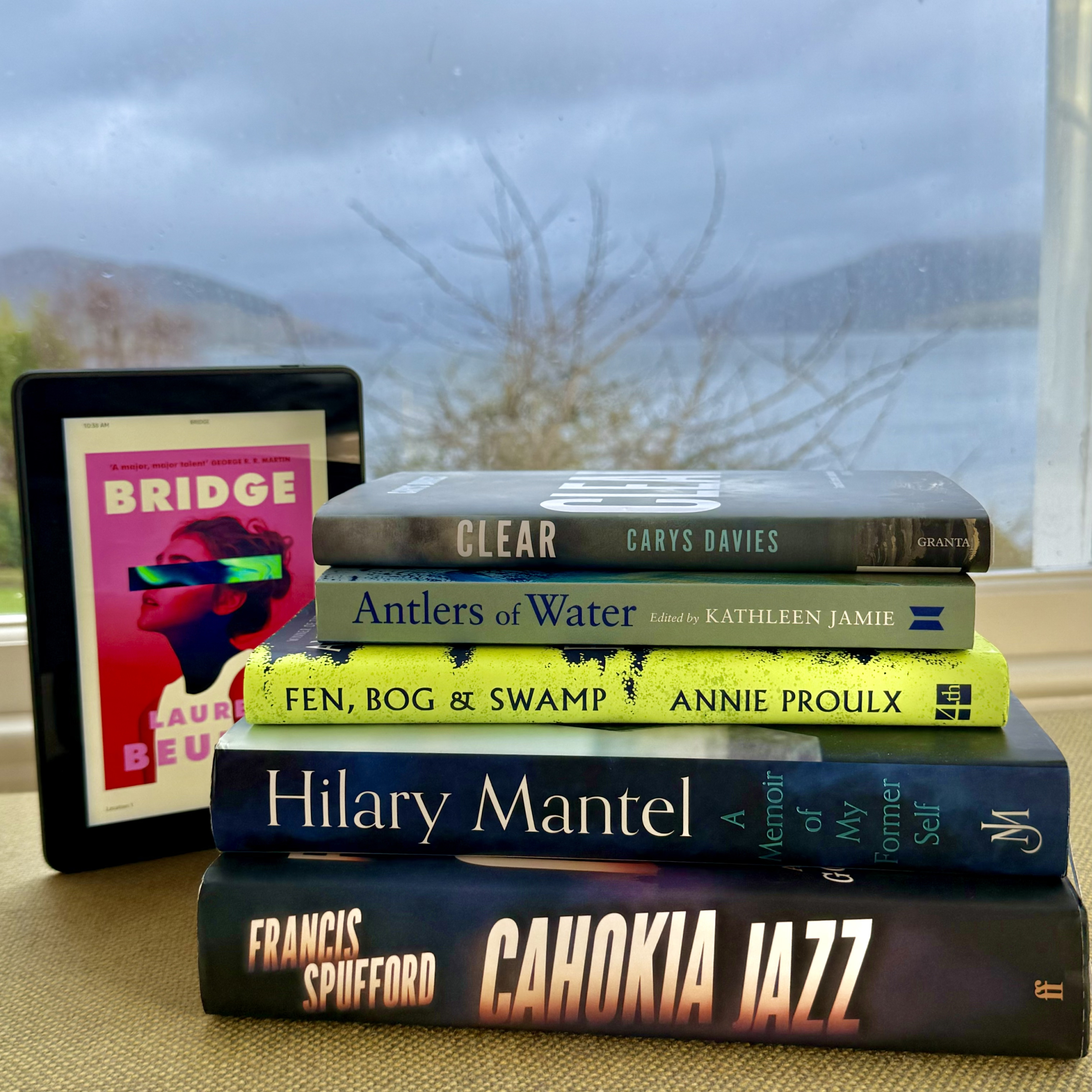
Judging by my spreadsheet ‘Books Read in 2025’, I have enjoyed an excellent year whether I’ve been reading for research or reading classics or keeping up with contemporary fiction. Here is a selection of my favourites together with a brief update on my writing year.
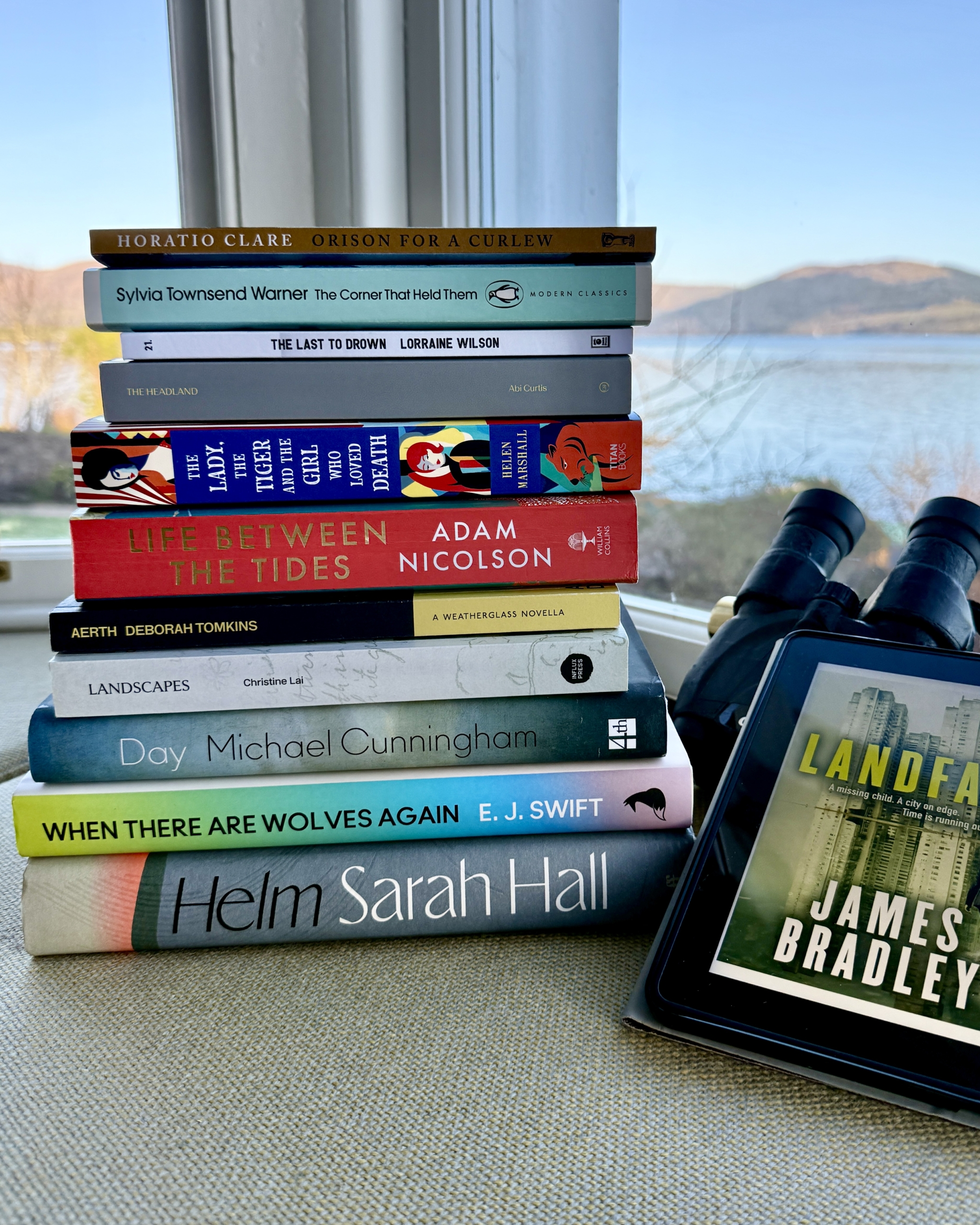
I like to start the year with a book of nature writing. To fill this seasonal slot, I read Adam Nicolson’s Life Between the Tides: In Search of Rockpools and Other Adventures Along the Shore. This delightful book helped me to appreciate, more deeply, the inter-tidal zones on the Isle of Bute where I have lived for the past eight years.
Michael Cunningham is a must-read author for me, and his novel Day became another early read in 2025. It did not disappoint. Day is a tender portrayal of love and loss, set during lockdown, and it’s yet another Cunningham masterpiece. I love everything he writes!
As per usual, I look out for novels with a climate/ecological angle. In that field, I’ve thoroughly enjoyed James Bradley’s speculative crime novel Landfall and Christine Lai’s near-future novel, Landscapes. And I read in manuscript E. J. Swift’s When There Are Wolves Again, which is an excellent pairing with her previous novel, The Coral Bones.
I am always drawn to novels with fragmented narratives especially those with a thread of historical fiction (I included a historical storyline in my second novel Sleeping Embers of an Ordinary Mind, and there’s a substantial historical element in my upcoming novel Alston Moor). This year I devoured Sarah Hall’s epic, multi-stranded novel Helm spanning from neolithic to contemporary times. The titular Helm is Britain’s only named wind. I also enjoyed Helen Marshall’s structurally complex novel, The Lady, The Tiger and The Girl Who Loved Death – another book I read in manuscript. The political and propaganda themes in this fantasy novel really drew me in.
Throughout 2025, I’ve found myself committed to reading a mass of non-fiction as research for my current work-in-progress. So, I’ve taken periodic breathers from heavy tomes by reading a number of compelling novellas including Aerth by Deborah Tomkins (winner of the Weatherglass Novella Prize) and The Last To Drown by Lorraine Wilson.
Somewhat belatedly, I read the brilliant, short memoir/travelogue, Orison for a Curlew: In Search of a Bird on the Edge of Extinction by Horatio Clare. An homage to the slender-billed curlew, this is also the human story of the birdwatchers and conservationists who have sighted this near-extinct bird.
Among several other novels I have admired, the ones that stayed with me are One Boat by Jonathan Buckley, and The Headland by Abi Curtis.
Despite the fact I’d finished writing Alston Moor, I have continued reading books relating, one way or another, to that novel. A case in point: prompted by an episode on the Backlisted podcast, I read The Corner That Held Them by Sylvia Townsend Warner, set in a medieval Norfolk convent. Unputdownable, for me at least!
Following several years of research and drafting, my fifth novel – Alston Moor – will be published in Autumn 2026 by Goldsmiths Press/Gold SF. Edits are now complete and I will be revealing the cover art soon!
Digital Advanced Reader Copies will be available for reviewers from Goldsmiths Press/GoldSF in the coming weeks.
In the meantime, I am scouring everyone’s end-of-year roundups to discover must-read books, which will jump to the top of the pile!
Wishing you all an eventful yet peaceful 2026.
Happy reading everyone!